
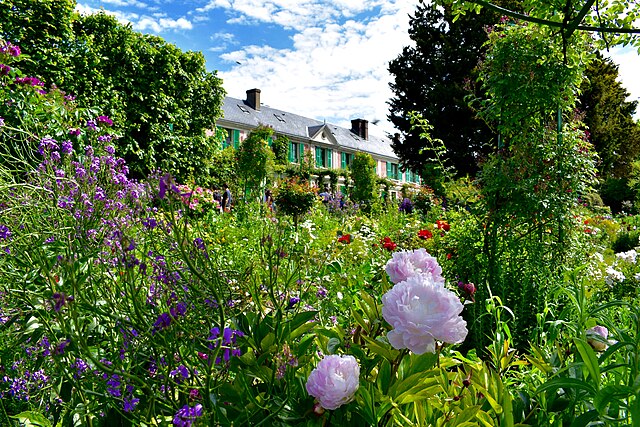
Paris to Giverny: Visit Monet’s Garden In One Day
“My garden is my most beautiful masterpiece” – Claude Monet
There is a moment – about thirty seconds after you pass through the low green gate at Giverny – when you stop walking. Not because you’re tired, not because the path is blocked, but because the sheer colour of the place lands on you like a warm hand on the shoulder. You had seen the famous images. But nothing quite prepares you for this: that the garden is real, and it is absurdly, overwhelmingly beautiful.
Claude Monet spent the last forty-three years of his life nurturing this two-hectare masterpiece in the Normandy countryside, two hours northwest of Paris. The water garden, the Japanese bridge, the tunnels of wisteria and the shivering clouds of nasturtiums. He didn’t just paint this landscape, he invented. Today, the Fondation Claude Monet preserves it exactly as he designed it, and a day trip from Paris to visit it is, without question, one of the most quietly life-changing things you can do in France.
Here is everything you need to know to make the most of a day trip from Paris to Giverny to visit Monet’s masterpiece.
Getting There: The Journey is Part of It
The route from Paris to Giverny requires a small adventure in itself – a pleasantly French combination of train and bus – from city to countryside.
By Train + Bus (the classic route)
From Paris Saint-Lazare, catch a SNCF train to Vernon-Giverny. Trains run regularly and the journey takes around 75 minutes. Vernon itself is a pretty Norman market town.
From the station, a seasonal shuttle bus runs directly to Giverny between April and October, costing around €10 return. Alternatively, you can hire a bicycle (from just outside the station) and the 5 km ride follows a flat, quiet road through apple orchards and meadows, and is genuinely lovely on a fine day.
TRAIN ESSENTIALS
- Paris Saint-Lazare → Vernon-Giverny: ~75 minutes
- First trains depart around 7am – aim to arrive at Giverny before 10am to beat the crowds
- Book on SNCF Connect or Trainline; tickets from ~€15 each way
- Vernon → Giverny shuttle: April–October only, runs on the hour
- Bicycle hire (outside the station): ~€8 for a half day
By Organised Tour
Several Paris-based operators run half-day or full-day guided tours to Giverny, typically departing from central Paris by minibus. These are convenient and often include skip-the-line entry, but you surrender some independence.
By Car
If you’re hiring a car in France, Giverny is about 80 km from Paris via the A13 motorway – roughly 75 minutes without traffic. Parking is available near the garden, though it fills quickly in July and August.
When to Go: Chasing the Light
The garden is open from the first of April to the first of November, and the right month to visit entirely depends on what you’ve come to see.
| APRIL – MAY Blossoms, tulips, and the wisteria drapes the Japanese bridge in violet. Crowds are manageable. Slightly unpredictable weather, but the light is exquisite. | JUNE – JULY Peak bloom. Irises, roses, poppies, and the allées of nasturtiums are in full glory. Also peak crowds so book well ahead and arrive early or late in the day. |
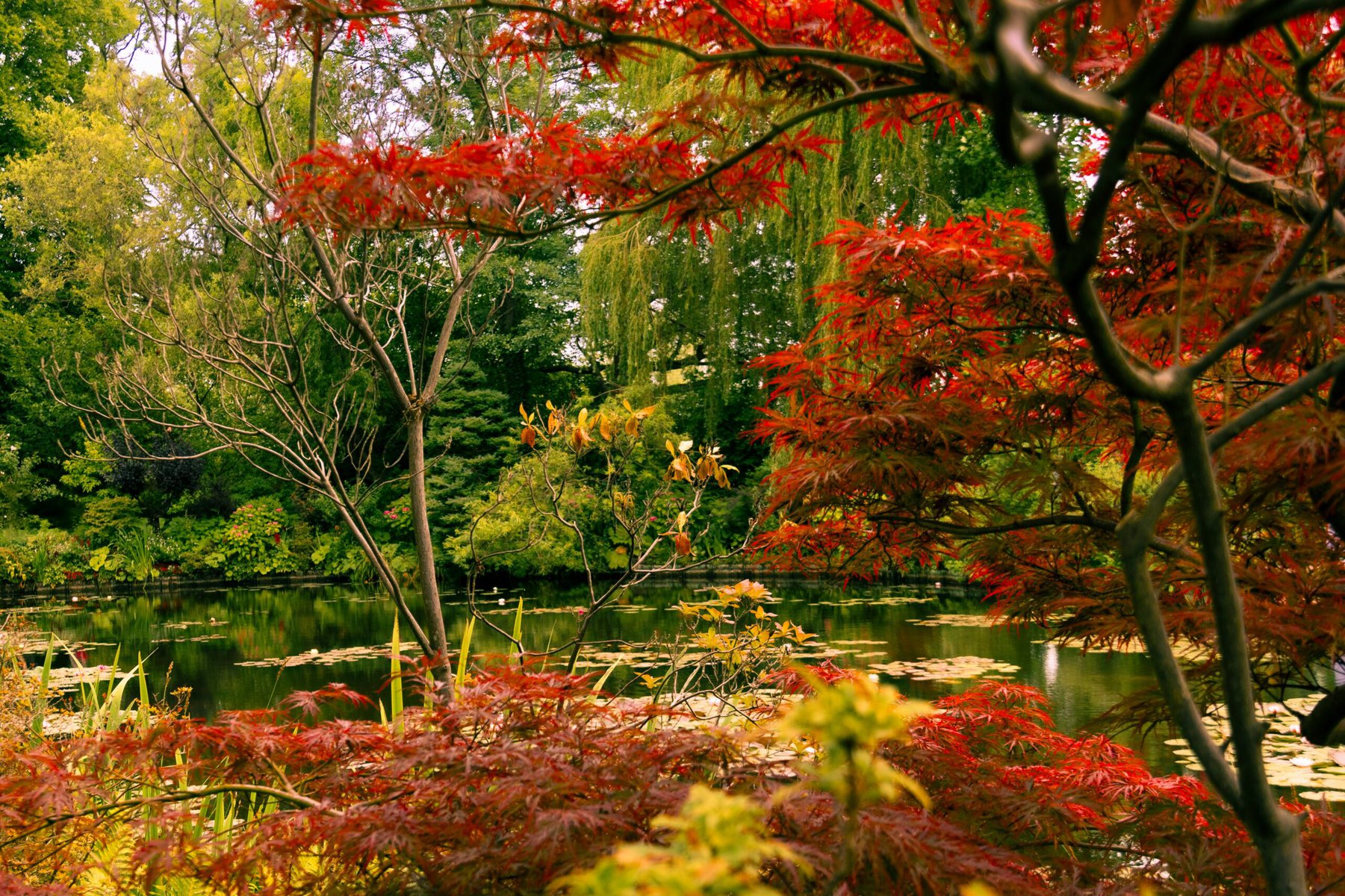
| AUGUST The water lilies are magnificent and the garden is lush, but this is the busiest month. Midweek visits are strongly preferable. Queues can be significant by mid-morning. | SEPTEMBER – OCTOBER Dahlias, sunflowers, and autumnal colour suffuse the garden. Crowds thin considerably after school returns. The light turns golden and Monet-like in the afternoons. |
Whatever month you choose, arrive as close to the 9:30am opening as possible. The garden before 11am belongs to a different, quieter world.
Inside the Garden: A Walk Through A Living Painting
Tickets should be booked in advance on the Fondation Claude Monet website. The entry includes access to both the garden and Monet’s house, and costs around €12 for adults. Allow at least two to three hours, though four is better if you’re the type who gets absorbed.
The Water Garden & Japanese Bridge
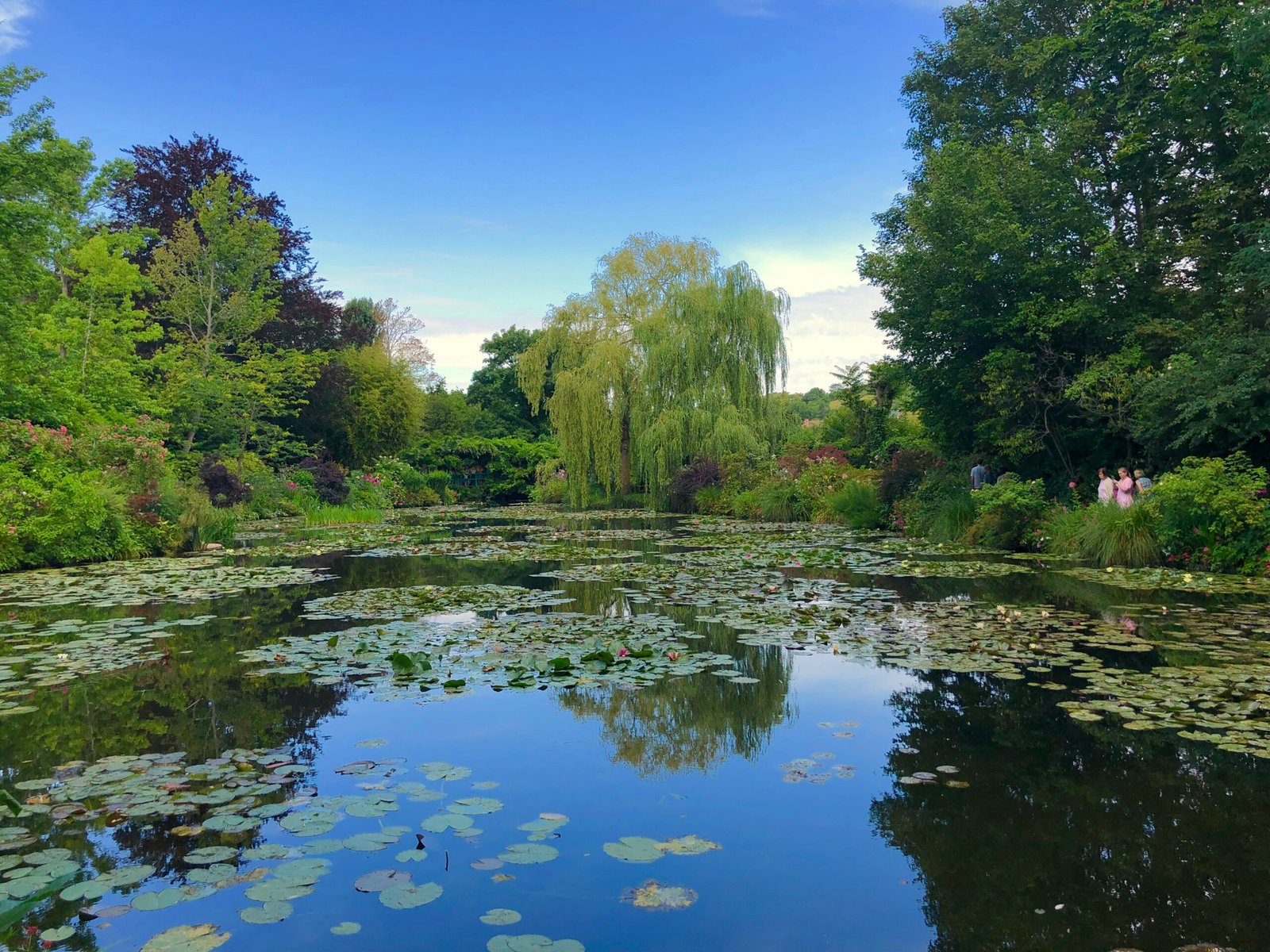
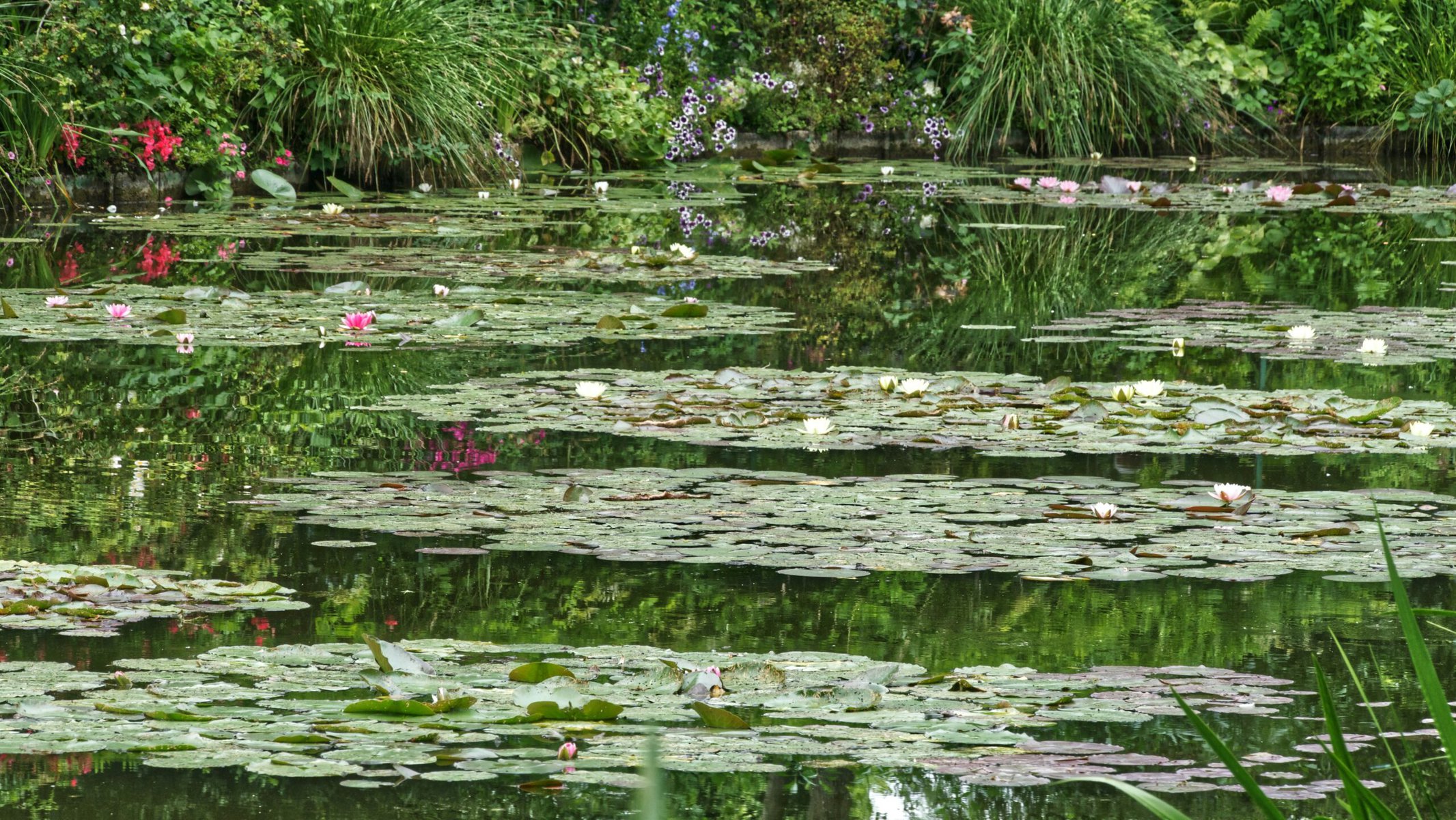
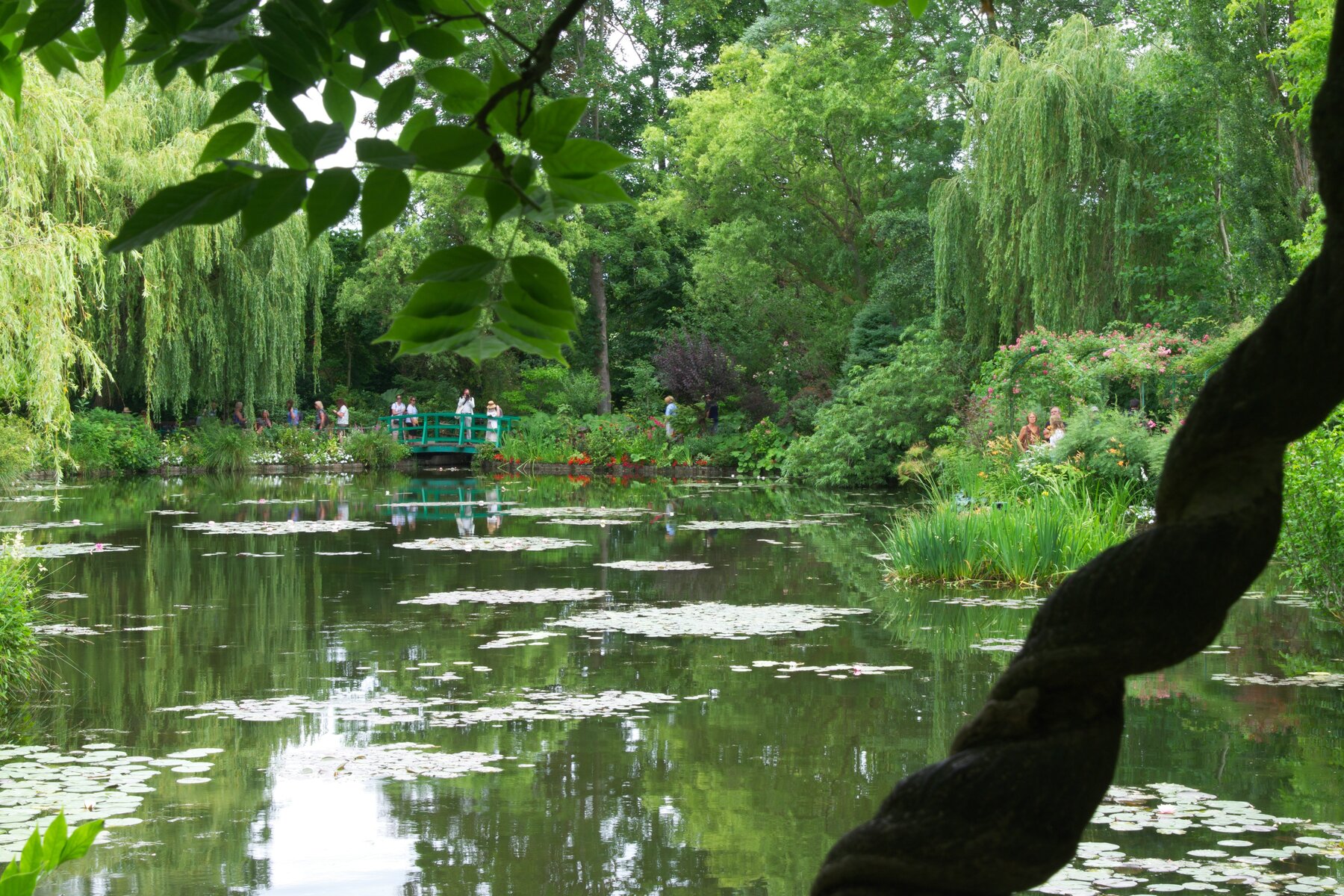
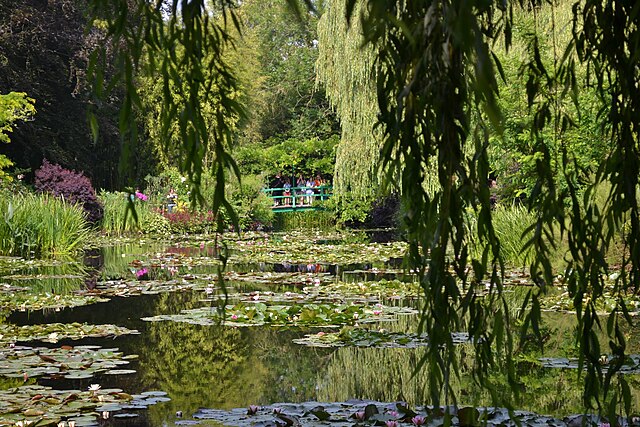
Enter through the pedestrian tunnel beneath the road and you emerge into the water garden – the part Monet added in 1893 after diverting a tributary of the Epte. This is the landscape of the Nymphéas: the weeping willows trailing their fingers in still water, the famous arched Japanese bridge hung with wisteria and glycine, the water lilies floating in every pink and white and yellow Monet ever put to canvas.
Spend as long as you need here. Sit on a bench. Let the light change. This is the point.
The Clos Normand – The Flower Garden
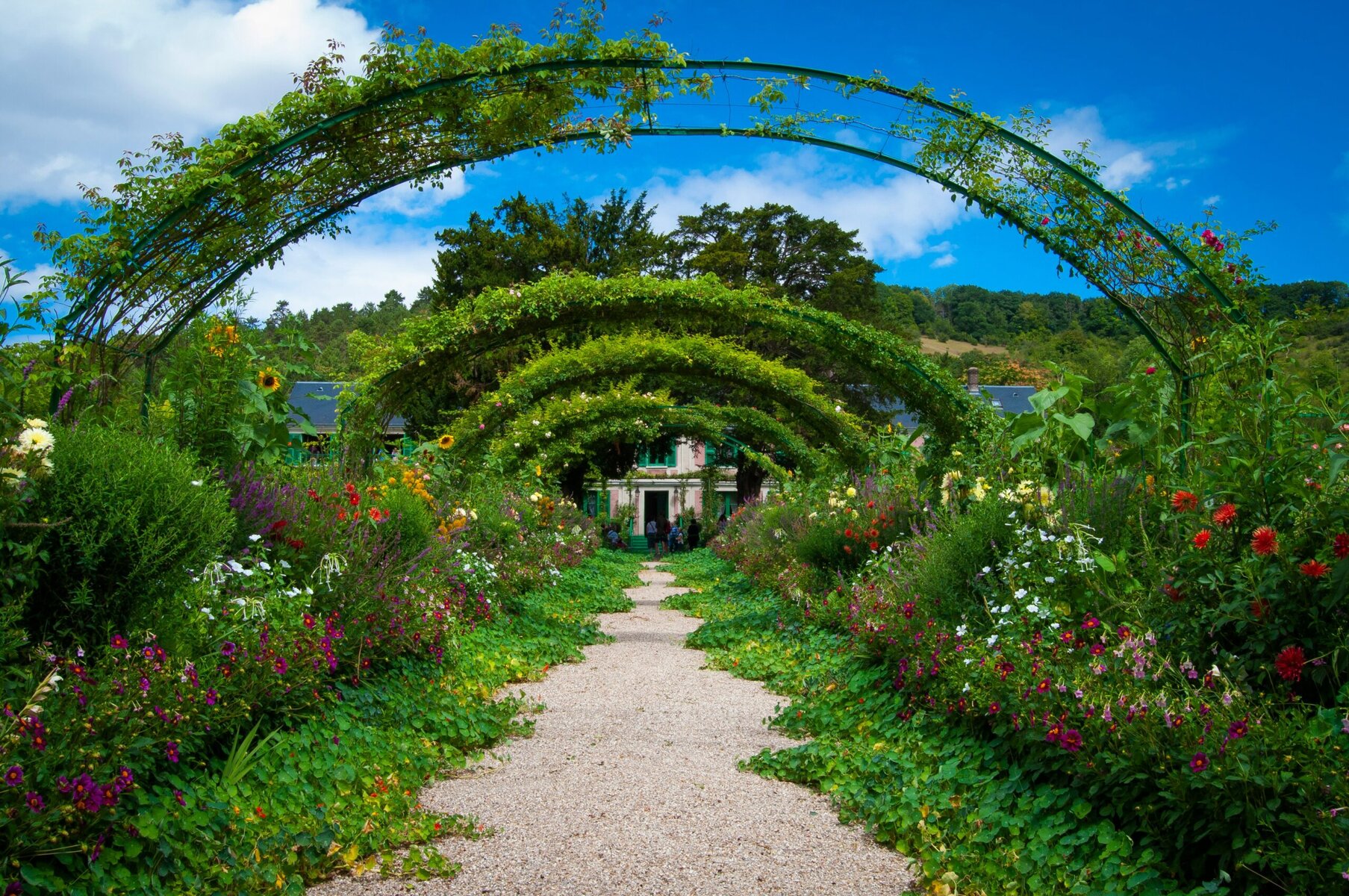
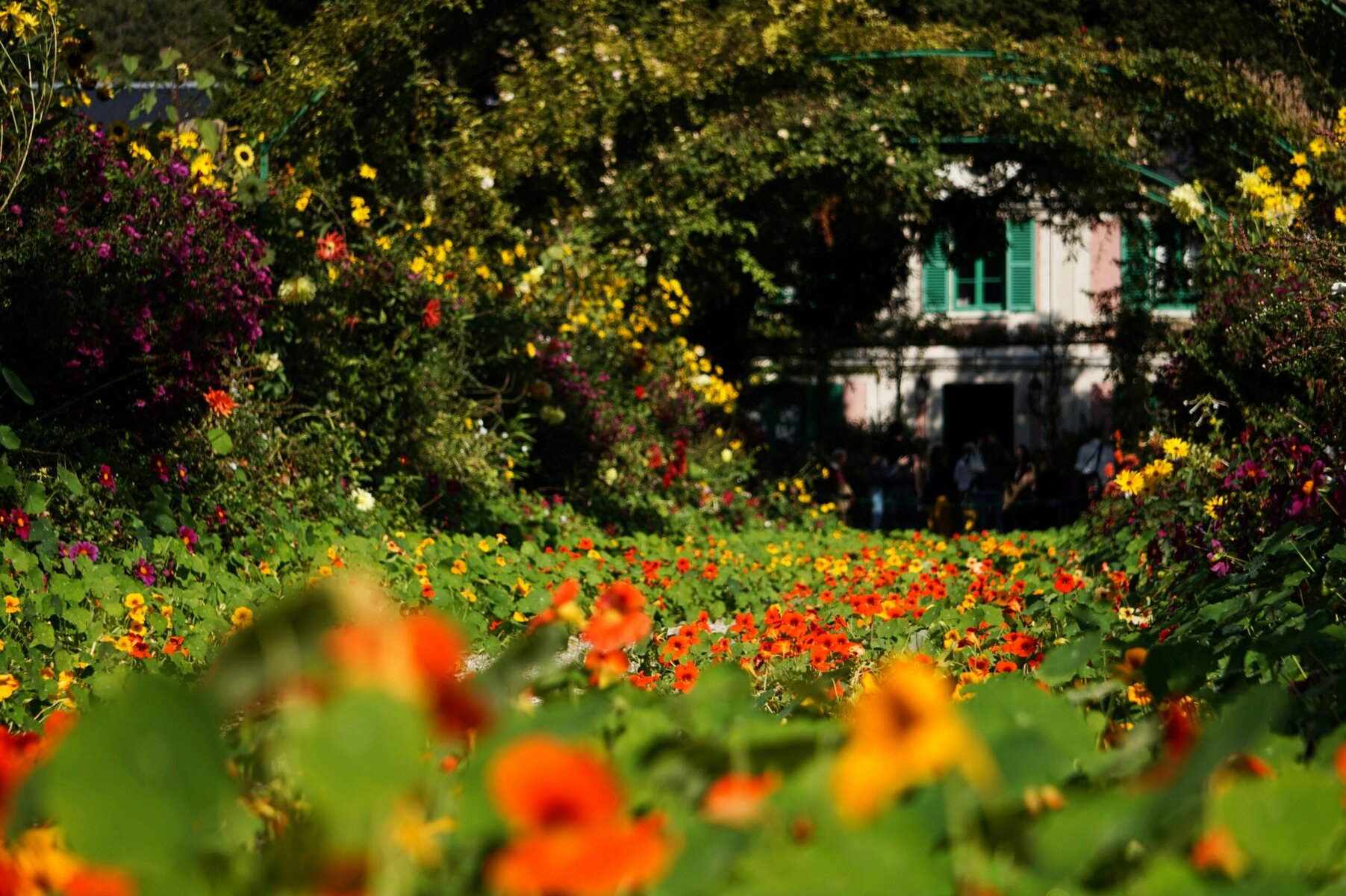
Cross back through the tunnel to the main garden, known as the Clos Normand. Two acres of formally structured garden beds spill over with gloriously informal colour – great waves of nasturtiums running along the central allée, rose arches, foxgloves, salvias, and whatever else is in season on the day you visit. The central avenue, lined with irises and standard roses, leads straight to the house.
Monet’s House
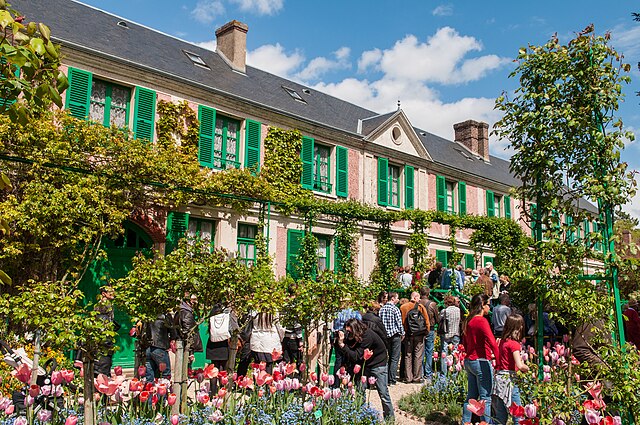
The famous pink house with its green shutters is every bit as painterly as the garden. Inside, the rooms have been restored to their condition during Monet’s lifetime – the cheerful yellow dining room, the blue kitchen with its gleaming copper pots, and the walls everywhere lined with Monet’s extraordinary collection of Japanese woodblock prints by Hiroshige and Hokusai.
Your Perfect Day: A Timeline
7:00 – 7:30 AM
Depart Paris Saint-Lazare
Grab a coffee at the station. Take a window seat – the Seine valley reveals itself quietly as Paris recedes.
8:45 – 9:00 AM
Arrive Vernon-Giverny station.
Collect your bicycle or board the shuttle bus. The 5 km ride through the valley is a lovely prelude to the garden.
9:30 AM
Gates Open at Giverny
Be among the first through the gate. Head straight for the water garden – this is when the light is softest and the crowds are thinnest.
10:00 – 11:30 AM
Explore the Clos Normand & the House
Take your time in the flower garden and wander through Monet’s pink house. Don’t rush the Japanese print rooms.
12:00 – 1:30 PM
Lunch in Giverny Village
The village has several lovely options. Le Jardin des Plumes is the restaurant of choice if you’re feeling indulgent. Les Nymphéas and the garden café are reliable for something lighter.
2:00 – 3:00 PM
Musée des Impressionnismes
A ten-minute walk from the garden, this excellent small museum places Monet and Giverny within the wider Impressionist story. Worth an hour of any art-lover’s afternoon.
3:30 – 4:00 PM
Return to the station.
BY 6:00 PM
Arrive back in Paris
In time for a verre de vin and an evening thinking about what you’ve seen.
Where to Eat: Lunch Among The Flowers
Giverny is a small village with a handful of restaurants, all of which are accustomed to feeding hungry travellers on a schedule. The options are better than you might expect for somewhere so tiny.
Le Jardin des Plumes is the most beautiful and most serious restaurant in the village – a Michelin-starred address set in a lovely old Norman house with a garden terrace. Booking is essential and prices are accordingly high, but if you’re celebrating or want to make the day especially memorable, lunch here is extraordinary.
Les Nymphéas, just opposite the garden entrance, is the comfortable middle ground: good Norman cooking, a proper menu du jour, and a terrace that fills up fast. Arrive before 12:30 or you’ll be waiting.
The garden café inside the Fondation serves sandwiches and salads – simple, quick, and perfectly placed if you’d rather spend your time in the garden than sitting down to a full meal.
Practical Notes: The Details That Matter
Before You Go
- Book garden entry in advance at fondation-monet.com – tickets sell out, especially in July and August
- The garden is closed on Mondays in some seasons – check the website
- Bring comfortable shoes; the paths are uneven in places
- A light jacket is wise even in summer – Normandy has opinions about weather
- Photography is encouraged everywhere except inside the house
- The gift shop sells excellent postcards and decent reproductions; the local honey is also worth buying
Beating The Crowds
- Arrive at opening (9:30 AM) or in the last two hours before closing (5:30 PM)
- Weekdays are quieter than weekends at any time of year
- Late September and October are genuinely quieter
- Tour groups typically arrive between 10:30 AM and 2:00 PM – plan around this window
So To Wrap Up Paris to Giverny: Visit Monet’s Garden In One Day…
What Monet understood – and what becomes obvious the moment you stand in the garden he made – is that art and life don’t need to be separate endeavours. The water garden was his greatest work, and he never had to frame it or hang it anywhere. It simply existed, changing with every season, every morning, every shift in the light.
You can see it too. Take the 7 AM train from Saint-Lazare. Be there when the gates open. Stand on the Japanese bridge for as long as you like. And try, just for a moment, to stop taking photographs and simply look.
It’s worth it. I promise it’s worth it.
Frequently Asked Questions
Answers to the questions I wished someone had answered for me before my first visit.
Do I need to book tickets in advance, or can I just turn up?
Advance booking is strongly recommended, and in peak season it is effectively essential. The Fondation Claude Monet operates a timed-entry ticketing system, and popular slots – particularly the 9:30 AM opening slot on weekends in June, July, and August – can sell out days or even weeks in advance. Walk-up visitors do sometimes get in, especially on weekdays outside peak season, but the risk of arriving at Giverny after a 75-minute train journey only to be turned away is not one worth taking.
Tickets are sold through the official Fondation Claude Monet website (fondation-monet.com). The booking process is straightforward and accepts most major cards. Print or save your ticket on your phone – the entry staff scan them at the gate. Children under 7 enter free; but double check. Reduced rates apply for students, young people aged 7–17, and visitors with disabilities.
One practical note: if you’re visiting as part of an organised tour, your guide will typically handle entry – but it’s always worth confirming this when you book the tour.
What is the best time of year to see the water lilies in bloom?
The water lilies in the pond at Giverny are at their finest from late June through to September, with the absolute peak typically falling in July and the first weeks of August. During these weeks, the surface of the pond is densely covered with open blooms in shades of white, blush pink, deep rose, and soft yellow – exactly the colours that fill the enormous Nymphéas canvases in the Musée de l’Orangerie in Paris.
Earlier in the season (April and May), the water lily pads are present but the flowers are only beginning to open. The compensation in spring is spectacular: the wisteria on the Japanese bridge peaks in late April to mid-May, producing heavy purple cascades that make the bridge almost more beautiful than it is in summer. The surrounding iris borders are also at their finest in May.
In September and October, the water lilies thin out but remain present, and the garden as a whole takes on a gorgeous autumnal warmth -dahlias, sunflowers, rudbeckias, and late roses replace the high-summer flowers. Many experienced visitors actually prefer this quieter, more golden season over the frantic peak of July.
How long should I allow for the visit? Is half a day enough?
The garden and house together take most visitors between two and three hours – but this is one of those rare places where time genuinely expands the longer you stay. If you treat it as a box to tick, two hours will cover the highlights. If you let yourself fall into it, four hours passes without effort.
The honest recommendation is to allow a full morning at the garden itself (9:30 AM to roughly 12:30 or 1:00 PM), followed by lunch in the village and an afternoon visit to the Musée des Impressionnismes Giverny – a small but excellent museum a short walk away that places the Giverny landscape within the broader context of Impressionism and American art. That combination fills a very satisfying full day.
The one thing that rewards patience specifically is the water garden: the reflections on the pond surface change continuously with the light and cloud. If you go early and then return to the water garden in the early afternoon when the light has shifted, you’ll see two entirely different paintings. Monet understood this better than anyone – he returned to the same view obsessively for decades precisely because it was never the same twice.
Is the cycle ride from Vernon to Giverny suitable for all fitness levels?
Yes – the ride is genuinely accessible to almost anyone comfortable on a bicycle. The route from Vernon station to Giverny covers approximately 5 kilometres on a dedicated cycling path and quiet country roads, with virtually no significant elevation change. It follows the flat Seine and Epte valleys through apple orchards and wheat fields, and on a fine day it is an absolute pleasure.
Most people of average fitness cycle it comfortably in 20 to 25 minutes. There are bicycle hire shops near Vernon station that offer standard bikes, electric bikes (ideal if you’d like a little assistance), and occasionally tandems or bikes with child seats for families. Electric bike hire costs a little more than standard but is well worth it if you’re travelling with children or simply want to arrive without a sweat.
One important caveat: the cycling path does include one section that follows a road with some traffic. It is well-managed and generally safe, but parents with young children should be aware. The shuttle bus is the easier alternative for families with small children or anyone who’d rather not cycle.
On the return ride, you’ll likely be slightly tired and well-fed, which makes the gentle downhill gradient back toward Vernon feel like a small gift.
Can I visit Giverny with young children? Is it suitable for families?
Giverny works well as a family destination, though some honest preparation helps. Children under 7 enter the garden free, and the garden itself – with its winding paths, the arched bridge over the pond, the dragonflies and frogs at the water’s edge, and the vivid sensory experience of thousands of flowers – tends to genuinely delight young children in a way that many art museums don’t.
The house can be trickier with very young or energetic children, as the rooms are small and the interiors are fragile. Strollers and pushchairs are not permitted inside the house, though the garden paths are generally pushchair-accessible (with some uneven sections). A baby carrier is useful if you’re travelling with an infant.
Practically: bring snacks, sunscreen, and hats for summer visits – there are sections of the garden with limited shade. The garden café is child-friendly. The shuttle from Vernon is much easier than cycling with children, unless you’re confident with bike seats or trailers. The Musée des Impressionnismes has a decent café and is compact enough that children who’ve burned their energy in the garden can manage a short visit.
Children who have seen any of the famous Nymphéas paintings beforehand – even in a picture book – tend to find the experience of the real pond magical. A small amount of preparation makes a genuine difference.
What is actually inside Monet’s house, and is it worth seeing?
Monet’s house – the famous pink stucco building with green shutters – is included in the general entry ticket and is emphatically worth seeing. It has been meticulously restored to its condition during Monet’s lifetime, and offers an intimate and revealing portrait of the man behind the paintings.
The yellow dining room is perhaps the most striking interior – a bright, sunny yellow from floor to ceiling, filled with the Japanese ceramics and blue-and-white Delft tiles Monet collected throughout his life. The blue kitchen, with its gleaming copper pots, hand-painted tiles, and cast-iron range, is equally beautiful and tells you a great deal about Monet’s appetite for sensory pleasure (he was a serious and devoted cook).
The rooms throughout the house are lined with Monet’s extraordinary collection of Japanese woodblock prints – works by Hiroshige, Hokusai, Utamaro, and others that he acquired from the 1870s onward. Seeing these prints in the rooms where Monet lived with them daily provides a fascinating insight into the visual sources of Impressionism: the flat colour planes, the bold cropping, the interest in light and season that characterise the woodblock tradition map directly onto the concerns of Monet’s own painting.
Photography is not permitted inside the house – a policy that initially frustrates but ultimately improves the experience. You end up actually looking at things rather than photographing them.
What happens if it rains? Is the visit still worthwhile in bad weather?
Rain is an entirely legitimate concern in Normandy, which has a pleasantly green but distinctly Atlantic climate. The honest answer is: a rainy visit to Giverny is still a very good day out, but it requires a certain philosophical adjustment.
Monet himself painted in the rain – and the garden in soft or overcast light has a misty, silvery quality that is genuinely beautiful in its own right, and much closer to the atmospheric conditions of some of his most famous works. The water garden in light rain, with ripples disturbing the lily-pad reflections, is something rather extraordinary. Many photographers actually prefer overcast days for the quality of the diffused light.
Practically: the garden paths can be muddy in heavy rain, and open-toed shoes or sandals are a mistake. Bring a proper waterproof jacket and (in the right season) waterproof trousers if you’re likely to be out for several hours. A compact umbrella is useful but manageable. The house interior offers shelter and is worth spending more time in on a wet day.
The one scenario worth planning for is thunderstorms, which can occasionally close the garden temporarily. If a severe weather forecast is predicted for your visit date and you have flexibility, it’s worth monitoring the French weather service (météo-france.fr) in the days before. Most rain, however, is light to moderate and entirely manageable.
Are there any other sights in Giverny or Vernon worth combining with the garden visit?
Yes – and thoughtfully combining them makes for a much richer day than the garden alone.
The Musée des Impressionnismes Giverny, a ten-minute walk from the garden entrance, is the most natural companion. Originally founded as an American art museum (Giverny attracted a significant colony of American painters in the late 19th and early 20th centuries who followed Monet’s lead), it now presents rotating exhibitions exploring Impressionism and its international legacy. The permanent collection context is excellent, and the building itself sits in a lovely garden. Admission is separate from the Fondation but modest.
In Vernon itself, it’s worth allowing twenty or thirty minutes to walk through the old town. The Collegiate Church of Notre-Dame, begun in the 11th century, has a remarkable Romanesque façade and a beautiful stained-glass rose window. The old mill (Moulin les Jumièges) perched dramatically on the remains of a medieval bridge over the Seine makes for an excellent photograph. There’s also a small municipal museum with some Monet-related material.
If you’re driving rather than taking the train, the nearby town of Les Andelys (20 km south) is genuinely spectacular – the ruined Château Gaillard, Richard the Lionheart’s great fortress, sits on chalk cliffs above a meander of the Seine in one of the most dramatic riverine landscapes in northern France. Combining Giverny with Les Andelys makes for an exceptionally full day in the Seine Valley.
Is Giverny accessible for visitors with mobility difficulties or disabilities?
The Fondation Claude Monet has made genuine efforts toward accessibility, though some limitations remain by virtue of the age and nature of the site.
The main flower garden (Clos Normand) is largely accessible by wheelchair and mobility aid, with relatively firm gravel paths. Some of the narrower beds and the allée edges can be slightly uneven, but the central avenue and most of the main paths are manageable. The water garden is similarly navigable, with firm paths around the pond and over the Japanese bridge, though some sections near the water’s edge are narrower.
Monet’s house presents more challenges: it is a 19th-century building with steps at the entrance and interior stairs between floors. Parts of the ground floor are accessible, but not the full house.
Visitors with disabilities receive a reduced ticket price. The shuttle from Vernon is accessible; the cycle route obviously is not. For visitors arriving by car, accessible parking is available near the garden entrance. The Fondation’s website has an accessibility section with current detailed information, which is worth checking ahead of your visit.
I’ve already seen the Nymphéas at the Musée de l’Orangerie – what else should I see in Paris before or after my Giverny trip?
Paris is, conveniently, one of the finest places in the world to deepen your understanding and enjoyment of Monet and Impressionism before or after visiting Giverny. Seeing the work in Paris and then standing in the landscape that inspired it creates a remarkable back-and-forth of meaning.
The Musée d’Orsay holds the most comprehensive collection of Impressionist painting in existence, including some of Monet’s finest early and middle-period works – the Haystacks series, Rouen Cathedral, and several exceptional garden scenes – as well as major works by Renoir, Degas, Pissarro, Sisley, and Morisot. A trip to the Orsay before your Giverny day out creates an ideal context.
The Marmottan Monet Museum in the 16th arrondissement is less visited than the Orsay but arguably more personally revealing: it holds the single largest collection of Monet’s work in the world, including the painting that accidentally gave Impressionism its name (Impression, Soleil Levant), donated by Monet’s son Michel. The late paintings – the enormous, nearly abstract water lily panels from his final years when his eyesight was failing – are here in extraordinary quantity and provide a fascinating coda to the Giverny visit.
For the broader context, the Petit Palais has an excellent and free permanent collection with strong Impressionist holdings. And if you haven’t yet seen the great oval rooms at the Orangerie, save them for your return from Giverny: standing among the monumental water lily panels after a morning at the pond they were painted from is an experience that connects the art and the landscape in a way that nothing else can replicate.
Can I stay overnight in Giverny, or is it day-trip only?
You can absolutely stay overnight, and for certain travellers – particularly those who want to experience the garden at truly quiet hours, or who want to explore the Seine Valley more broadly – an overnight stop is worth seriously considering.
Giverny village itself is tiny and accommodation options within the village are limited to a handful of chambre d’hôtes (bed and breakfasts) and one or two small guesthouses. These tend to be charming, personal, and often booked well in advance – particularly the ones with garden terraces within walking distance of the Fondation. The experience of wandering around the village in the early evening after the day-trippers have left, when the lanes are quiet and the light is long, is genuinely special.
Vernon offers more conventional hotel options and is only 5 km away – a more practical base if you want reliability and a wider choice of restaurants for dinner. Several good hotels cluster near the train station and along the riverfront.
The great advantage of staying overnight is the early morning: if you’re at the garden gate at 9:30 AM on the dot when it opens – before the organised tour buses arrive between 10:30 and 11:00 – you’ll have a substantially quieter experience of the water garden. Guests staying locally can simply walk over; those arriving by train face a minimum 75-minute journey from Paris plus the shuttle, making the earliest entry slot quite demanding as a same-day trip.
Le Jardin des Plumes, the Michelin-starred restaurant in Giverny, also has a small number of beautifully appointed rooms above the restaurant – making it possible to combine an exceptional dinner, a night’s sleep, and an early morning in the garden into one very civilised 24 hours.
Can I use a drone at Giverny?
No – drone flying is not permitted at the Fondation Claude Monet or anywhere over the village of Giverny. This applies to both recreational and professional use, and the restriction is firmly enforced.
There are several reasons for this. The garden is a protected historic site and a working horticultural environment – the noise and disturbance of drone flight would significantly impact other visitors’ experience of what is, for many people, a deeply quiet and contemplative place. Beyond the Fondation’s own rules, French aviation law also imposes strict regulations on drone use over heritage sites, populated areas, and crowds of people. Giverny falls into multiple restricted categories under these national rules.
For photographers hoping to capture aerial or elevated perspectives, the honest answer is that the most extraordinary images of Giverny are taken at ground level – and often at water level, with a camera held low over the pond surface to capture the lily-pad reflections. Monet himself, after all, painted from the banks. Some of the most celebrated photographs of the garden were taken from the Japanese bridge looking down, or from the willow-draped edges of the water garden looking across.
In short: leave the drone at home, and bring a good wide-angle lens instead.
For some more great travel hacks, head to our dedicated Travel Hacks page.